How to choose your first telescope without overspending
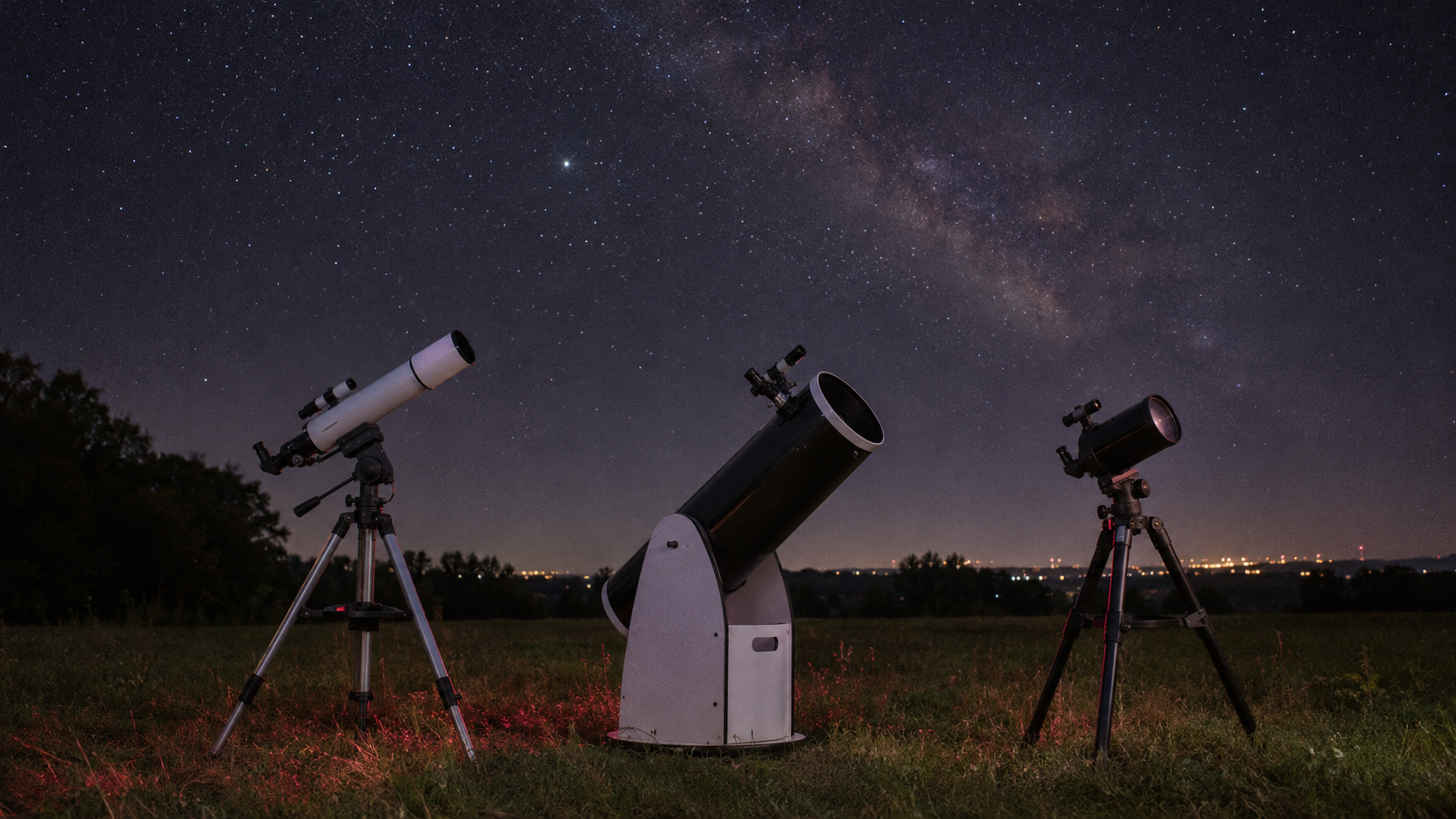
Choose a first telescope by its aperture — the diameter of its main lens or mirror — rather than by advertised magnification. A larger aperture gathers more light and reveals more detail. At the same time, the telescope must be light enough that you will actually take it outside. The Planetary Society gives the same practical advice.
Main telescope types
A 70–100 mm refractor uses lenses. It needs almost no adjustment, is ready quickly, and works well for the Moon, planets, and bright star clusters. It is a good choice for a balcony or short sessions, but large high-quality lenses are expensive.
A 130–200 mm Newtonian reflector uses mirrors. On a simple Dobsonian mount it offers the most aperture for the money and works for nebulae, galaxies, the Moon, and planets. Its drawbacks are size and occasional mirror collimation.
A 90–127 mm Maksutov is compact and especially capable on the Moon and planets. It is easy to store, but has a relatively narrow field of view and needs time to cool before observing.
What to buy
For a balcony or frequent short sessions, consider an 80–100 mm refractor or a 90–127 mm Maksutov. For visual observing from a yard or on trips, a 150 mm Dobsonian is a sensible all-round choice; if storage and transport allow, consider 200 mm.
Choose a stable mount: a shaky tripod damages the view more than a small difference in optics. A simple alt-azimuth or Dobsonian mount is easier for beginners than an equatorial one. Astrophotography has different requirements — there, the mount matters more than the optical tube. See the guides from Sky & Telescope and the RASC for more detail.
Check the clouds for your location on the NightSkyCast map