Webb Reconstructs a Star’s Final Hours From Cassiopeia A Dust
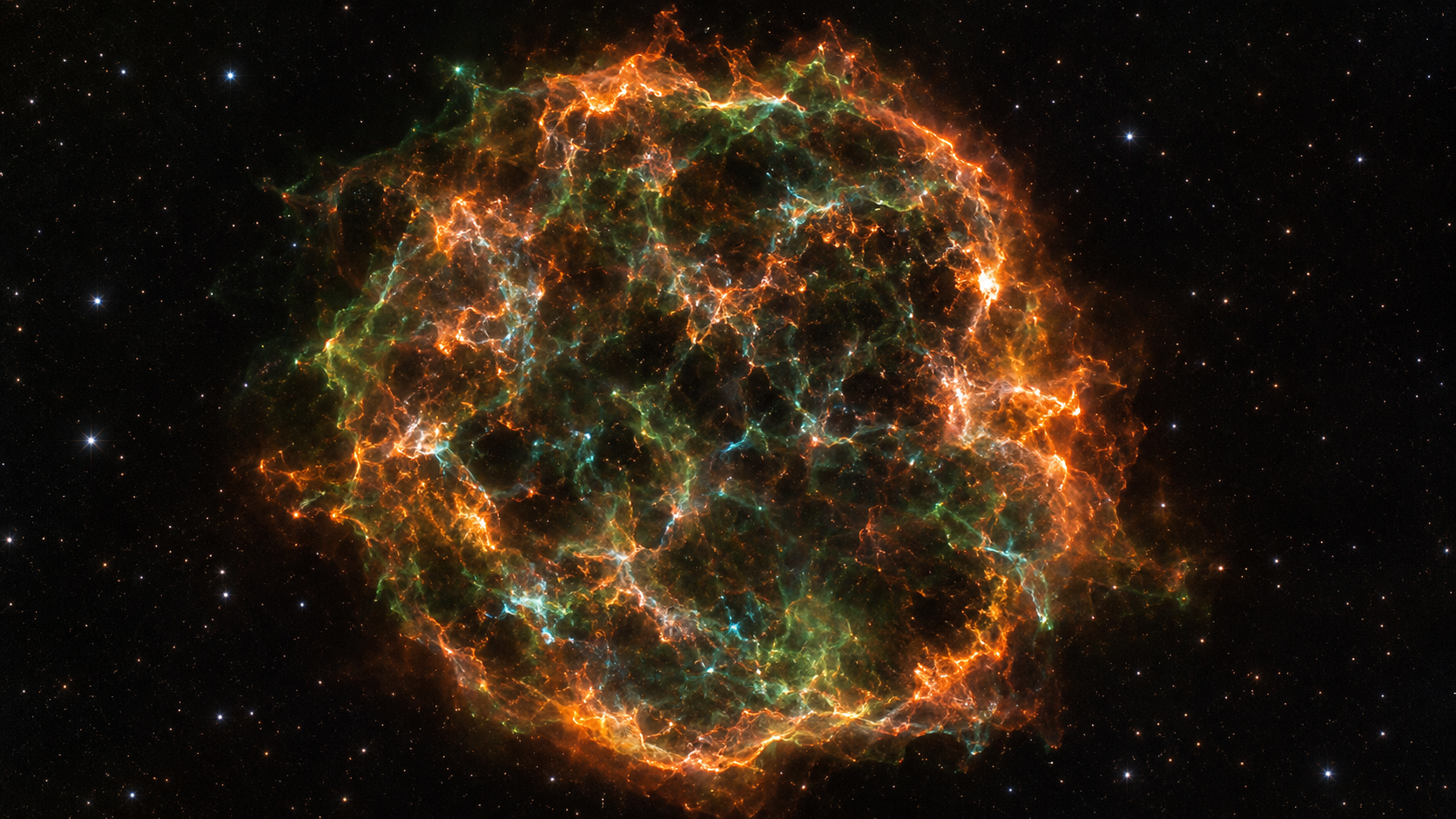
On November 23, 2026, NASA published a new study of the Cassiopeia A supernova remnant. Mid-infrared observations by the James Webb Space Telescope resolved the chemical composition of individual dust clumps roughly the size of the solar system.
The map revealed strikingly different regions. One ejecta area is dominated by silica dust, while another is rich in carbon dust. The structure known as the Green Monster contains complex magnesium silicates and likely formed from material the star shed before it exploded.
This distribution supports a shell-merger scenario inside the progenitor star. Before core collapse, massive stars contain layers where different nuclear-burning reactions occur. Webb found evidence that these layers began mixing shortly before the supernova — possibly only hours before the core collapsed.
The researchers combined Webb data with observations from Spitzer, Chandra, and XRISM. The dust therefore acts as a record of the dead star’s final evolutionary stages. The method could help astronomers infer the internal structure of other supernova progenitors and understand which elements they distribute into the galaxy for future stars and planets.
The result was published in The Astrophysical Journal Letters.
Check clouds for your location on the NightSkyCast map