Eyepieces and magnification: what beginners actually need
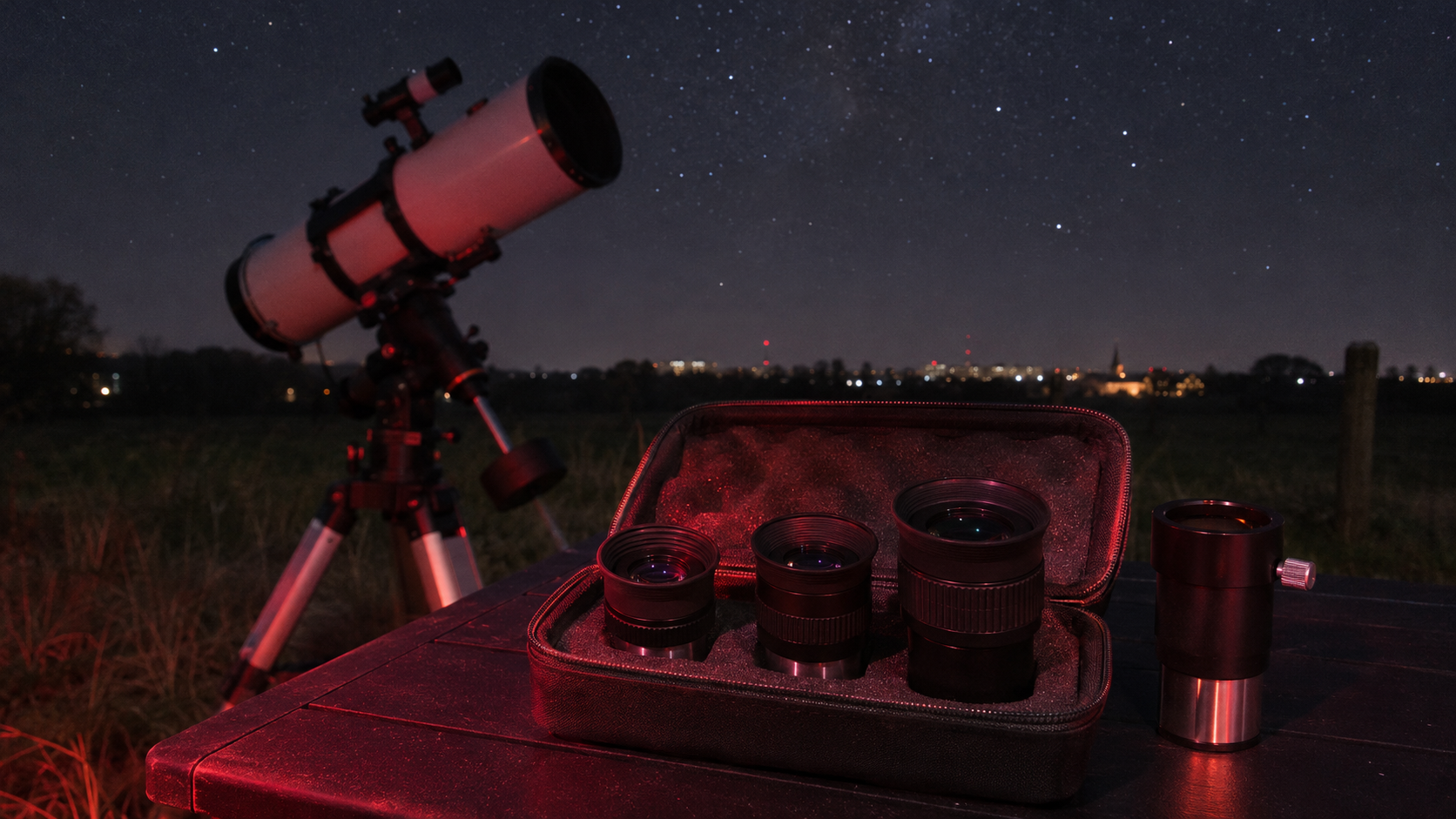
An eyepiece determines a telescope’s magnification and field of view, but the shortest eyepiece does not necessarily give the best image. Magnification is easy to calculate: divide the telescope’s focal length by the eyepiece focal length. For example, a 650 mm telescope with a 10 mm eyepiece gives 65×.
Which eyepieces do you need?
Start with three useful ranges. Low power, 25–50×, is convenient for finding targets and viewing large clusters and nebulae. Medium power, 60–120×, suits the Moon and most planetary observing. High power, 130–200×, is for small details only when the atmosphere is steady and the telescope has cooled properly.
For a telescope with a 650 mm focal length, a sensible set is roughly 20–25 mm, 10 mm, and 5–7 mm. A 4 mm eyepiece gives about 163×: it is not useless, but the image often becomes dimmer and more sensitive to atmospheric turbulence. The RASC recommends always starting at low power and increasing it gradually.
Do you need a Barlow lens?
A 2× Barlow doubles the magnification of any eyepiece: a 10 mm behaves roughly like a 5 mm. It is a convenient way to expand a small collection, but a Barlow cannot create new detail. Poor optics, a shaky mount, or bad seeing become more obvious at higher power. Celestron’s instructions also recommend beginning with a low-power eyepiece.
Do not buy a case filled with ten cheap eyepieces. Two or three comfortable eyepieces with a decent field of view are usually more useful. OpenStax Astronomy explains the fundamentals of telescopes and aperture.
Check the clouds for your location on the NightSkyCast map