ESA Selects Plasma Observatory, a Seven-Spacecraft Mission
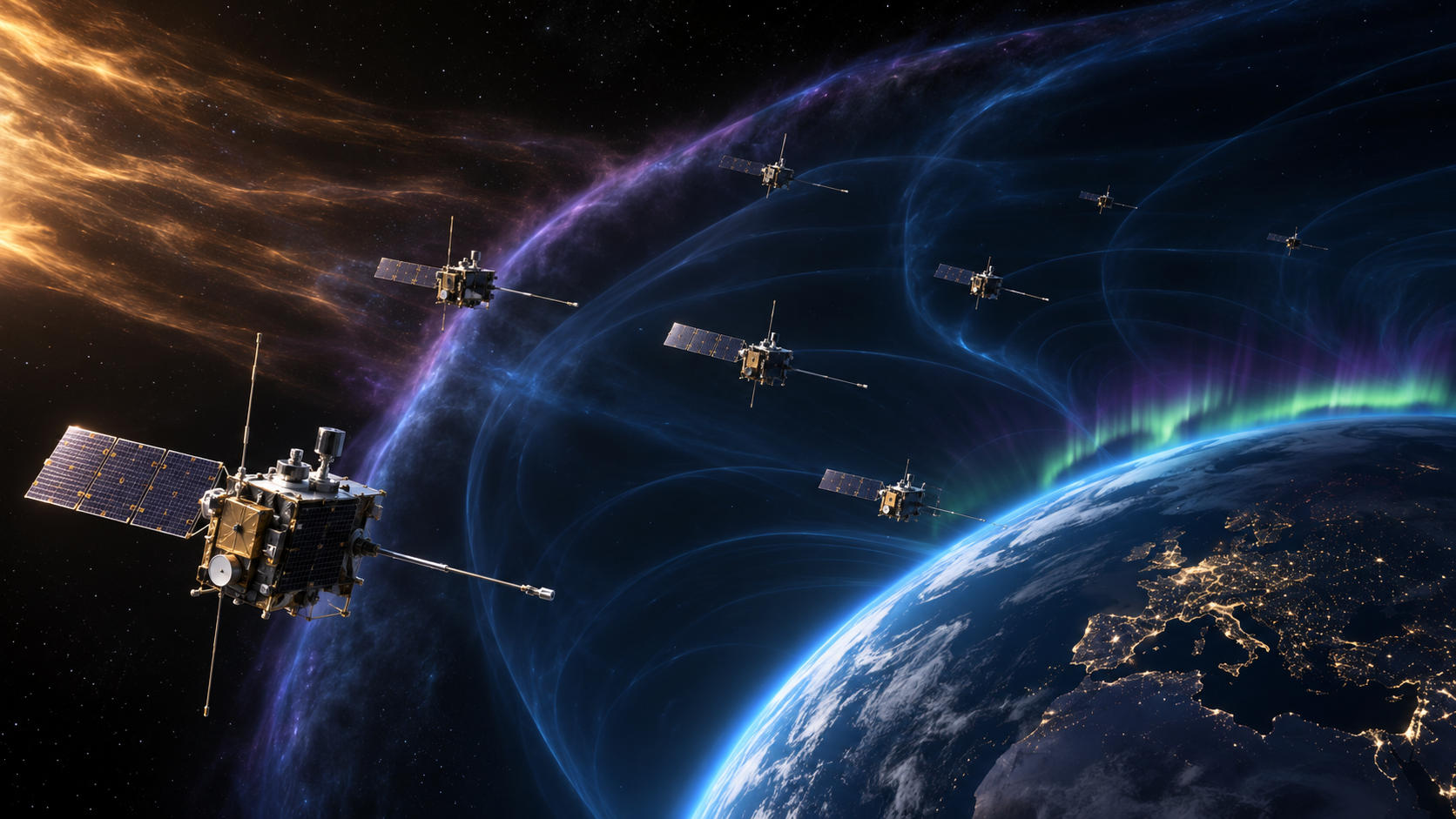
On 19 November 2026, European Space Agency Member States selected Plasma Observatory as ESA’s next medium-class science mission. It will fill the M7 slot and become the first medium-class mission in the Voyage 2050 programme, according to ESA.
The mission’s defining feature is a formation of seven spacecraft operating at different points within Earth’s magnetosphere. They will simultaneously measure electric and magnetic fields as well as charged particles. This arrangement will let researchers connect rapid processes spanning only a few kilometres with changes extending across tens of thousands of kilometres.
Earth’s magnetosphere shields the planet from most of the solar wind. The strongest interactions can produce auroras, but they may also disrupt satellites and critical power-grid infrastructure. The new mission is designed to reveal how energy from the Sun enters Earth’s magnetic environment, moves between its regions and accelerates particles.
Selection does not mean construction begins immediately. The project must still pass ESA’s formal adoption stage before the spacecraft are built. Launch is provisionally planned for the late 2030s. Plasma Observatory will build on ESA’s Cluster mission, while observing several spatial and temporal scales at the same time for the first time.
Check the clouds for your location on the NightSkyCast map