CTAO-South to Gain Two Large Gamma-Ray Telescopes
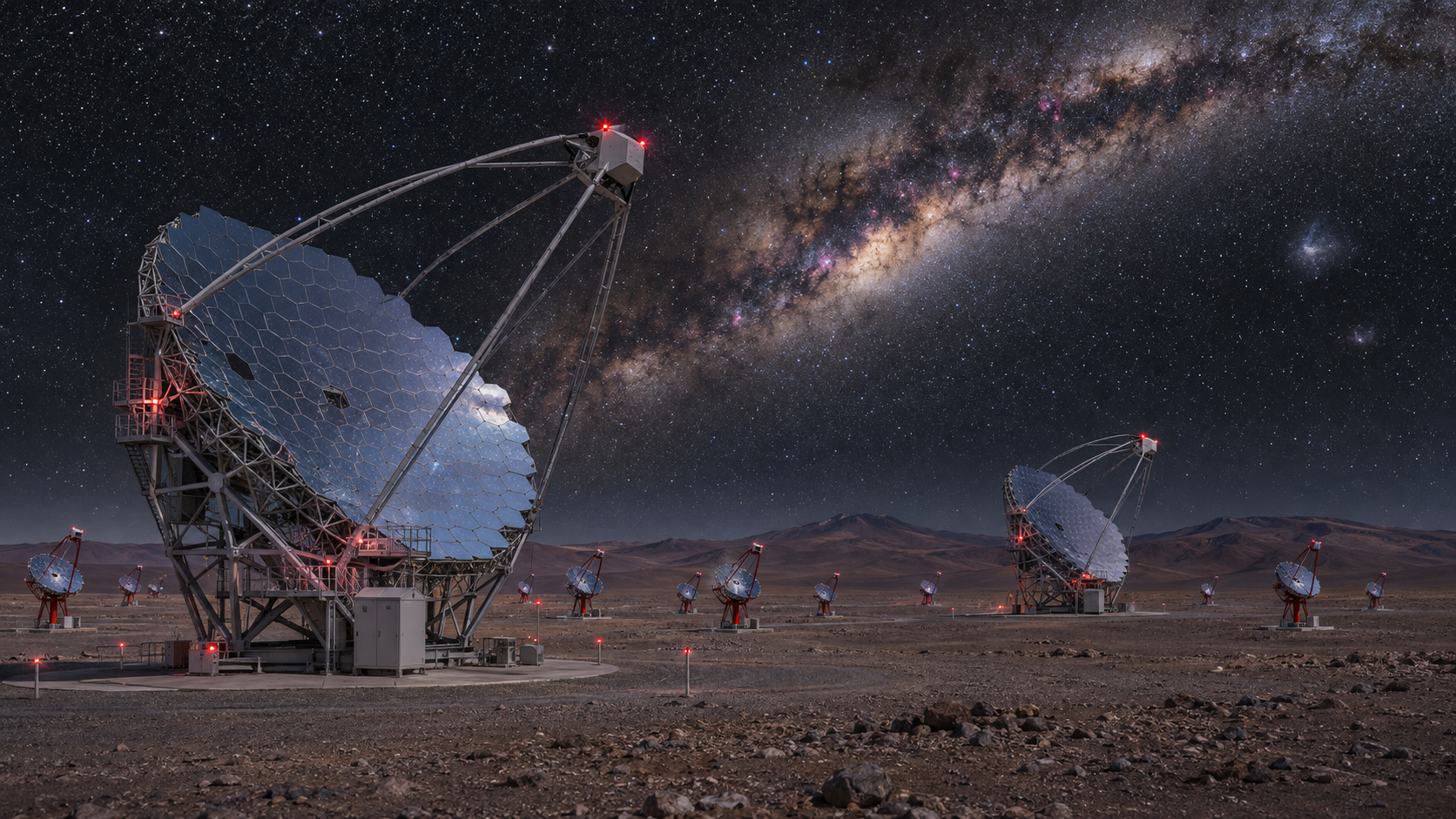
The southern array of the Cherenkov Telescope Array Observatory in Chile’s Atacama Desert will be more powerful than originally planned. ESO announced on November 19 that two Large-Sized Telescopes, or LSTs, will be added to CTAO-South near Paranal Observatory. Together with the planned medium- and small-sized instruments, the array will contain 53 telescopes.
CTAO will study the most energetic phenomena in the universe, including gamma-ray bursts, active galactic nuclei, supernova remnants, and possible sources of cosmic rays. Gamma-ray photons do not reach Earth’s surface directly. When they strike the atmosphere, they produce particle cascades and extremely brief flashes of Cherenkov light that telescope mirrors can detect.
The LSTs are particularly important for relatively low-energy gamma rays, which create the faintest flashes. ESO estimates that the two new telescopes will double CTAO-South’s sensitivity between 50 and 80 GeV and improve it by about 25% between 80 and 300 GeV. Their rapid pointing will help catch short-lived events before they fade.
Site preparation is already under way: 17 kilometers of roads have been built, along with foundations for small and medium telescopes. The LST foundations are expected to be completed by the end of the year. Together with CTAO-North on La Palma, CTAO will become the world’s largest gamma-ray observatory.
Official ESO announcement and the CTAO website.
Check clouds for your location on the NightSkyCast map