Voyager 1 reaches a distance of one light-day from Earth
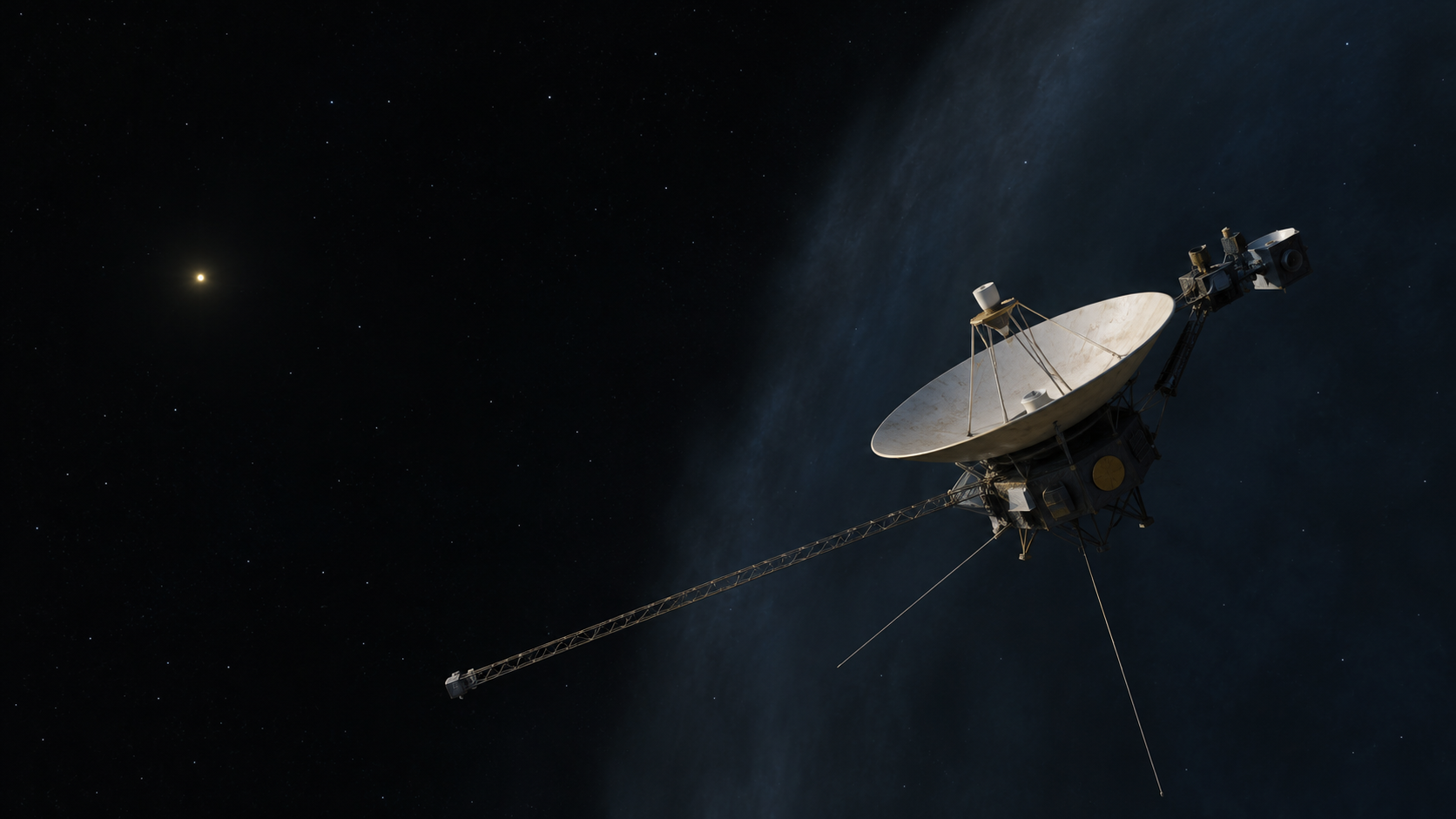
On 18 November 2026, Voyager 1 became the first human-made spacecraft to reach a distance of one light-day from Earth. NASA listed the milestone distance at about 25.9 billion kilometres.
A light-day is a unit of distance, not the spacecraft's travel time. It is the distance light covers in 24 hours. A radio signal sent from Earth now takes roughly a day to reach Voyager 1, and a response requires roughly another day to travel back.
The spacecraft launched in 1977. After exploring Jupiter and Saturn, it continued outward and now operates beyond the heliosphere, the region dominated by the solar wind. Reaching this milestone does not mean Voyager is close to another star: interstellar distances are vastly greater.
The long communication delay changes mission operations. Engineers cannot receive an immediate response to a command, so every action must be planned carefully and spacecraft health is assessed from telemetry arriving with a huge delay.
Voyager 1 cannot be seen through even a large amateur telescope. The milestone nevertheless gives a clear sense of the Solar System's scale and the enormous difference between spacecraft speed and the speed of light.
Source: NASA.
Cover: AI-generated illustration, not an official image.
Check clouds for your location on the NightSkyCast map