Star, planet, satellite or meteor?
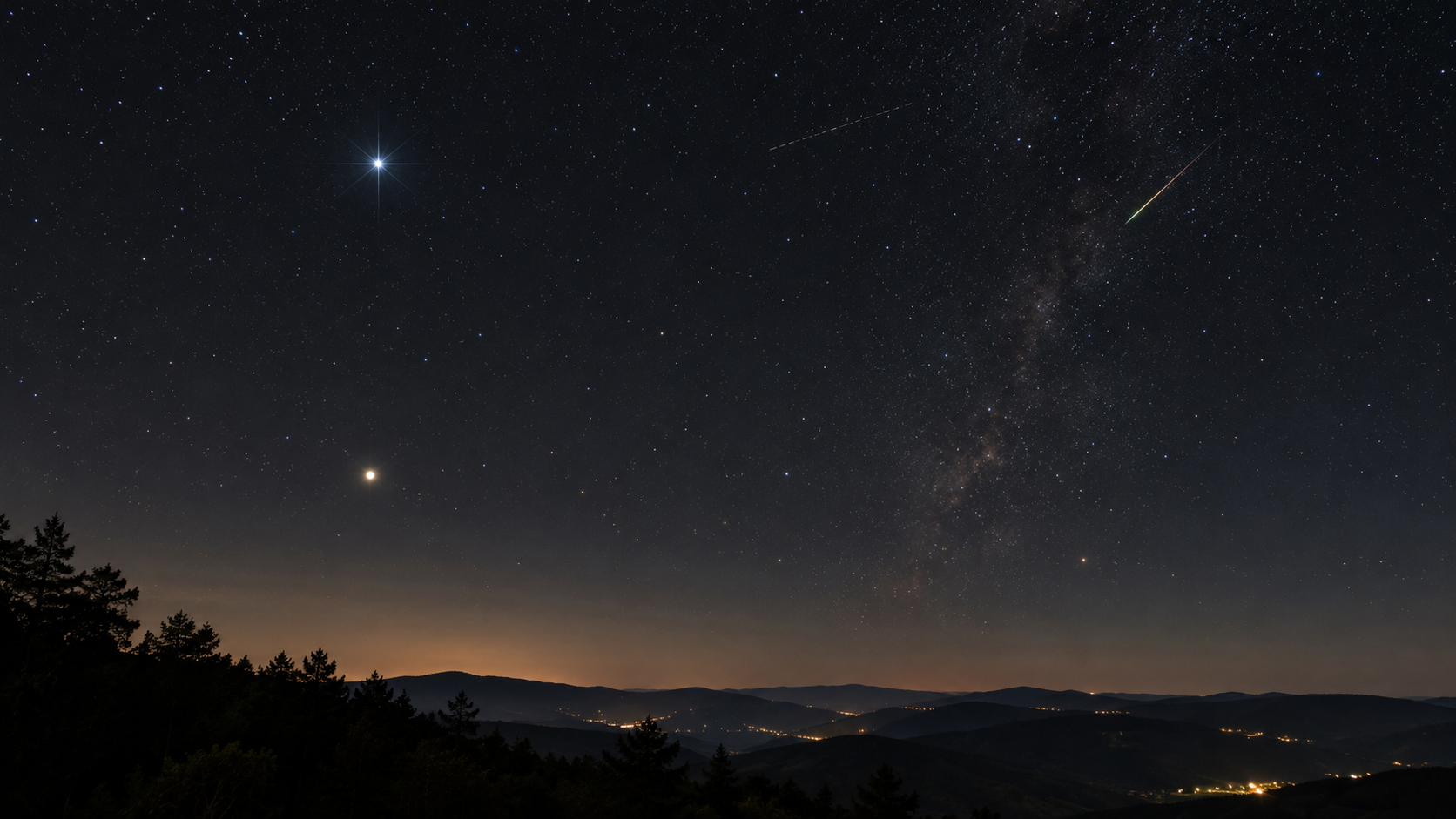
A bright point in the sky could be a star, planet, artificial satellite or meteor. Watch it for a few minutes and notice its motion and twinkling. Stars usually twinkle more, especially near the horizon, because moving air changes the path of their light. Planets also look like bright points but often twinkle less; their positions against the constellations shift gradually from night to night.
A satellite moves smoothly across the sky and may cross a large area in a few minutes. It does not leave a bright trail and may fade as it enters Earth’s shadow. A meteor is a brief flash or streak of light, usually lasting a fraction of a second to a few seconds. It does not “fall” toward the observer; it burns up in the atmosphere.
Checking your guess
Remember the direction and time, then compare your sighting with a planet chart or satellite-pass tracker. Do not rely on one clue: aircraft have blinking lights, and bright stars can twinkle strongly in turbulent air. If an object suddenly flashes and quickly fades, it was probably a meteor.
Check clouds for your location on the NightSkyCast map