How to see Jupiter’s four largest moons
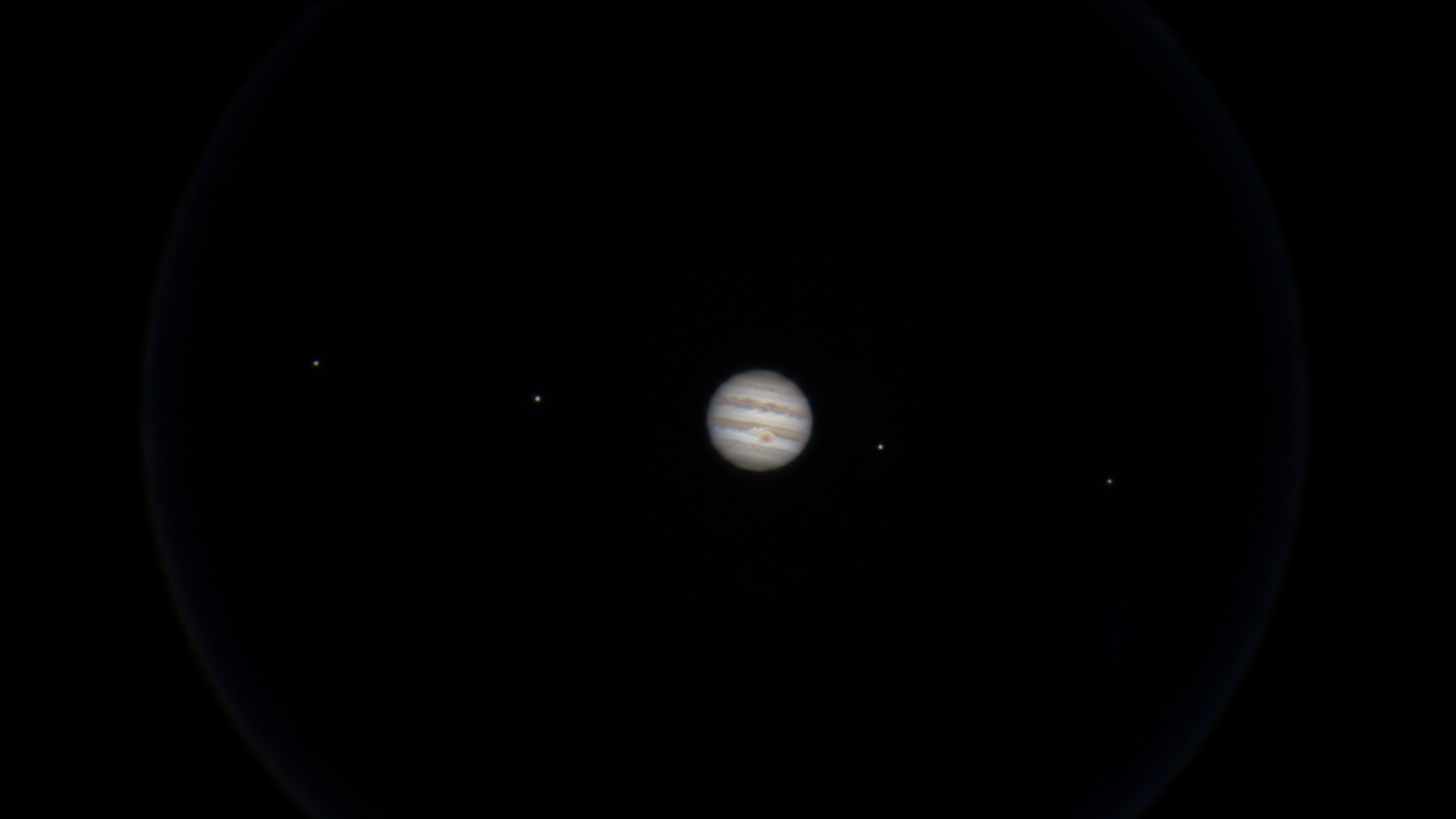
Jupiter’s four largest moons—Io, Europa, Ganymede and Callisto—are called the Galilean moons. They appear as tiny points beside the planet and can be seen with a small telescope under steady skies. High magnification is not necessary; a lower-power eyepiece may show the whole arrangement around bright Jupiter.
The moons’ positions keep changing as they orbit the planet. One evening, points may appear on both sides of Jupiter; another night, a moon may pass in front of the disk, behind it or through its shadow. Do not identify them by position alone: compare the observing time with a sky chart or interactive ephemeris.
What to look for
Set the telescope on a stable support and begin with low magnification. Let your eyes adapt, then look for faint points on either side of the planet. A moon can be hard to see when it is close to Jupiter’s bright disk or crossing in front of it. If fewer than four points appear, a moon has not vanished; it may be hidden or in shadow. Note the time so you can compare positions later.
Check clouds for your location on the NightSkyCast map