Dust Grains Point to an Ancient Ice Reservoir Beyond Neptune
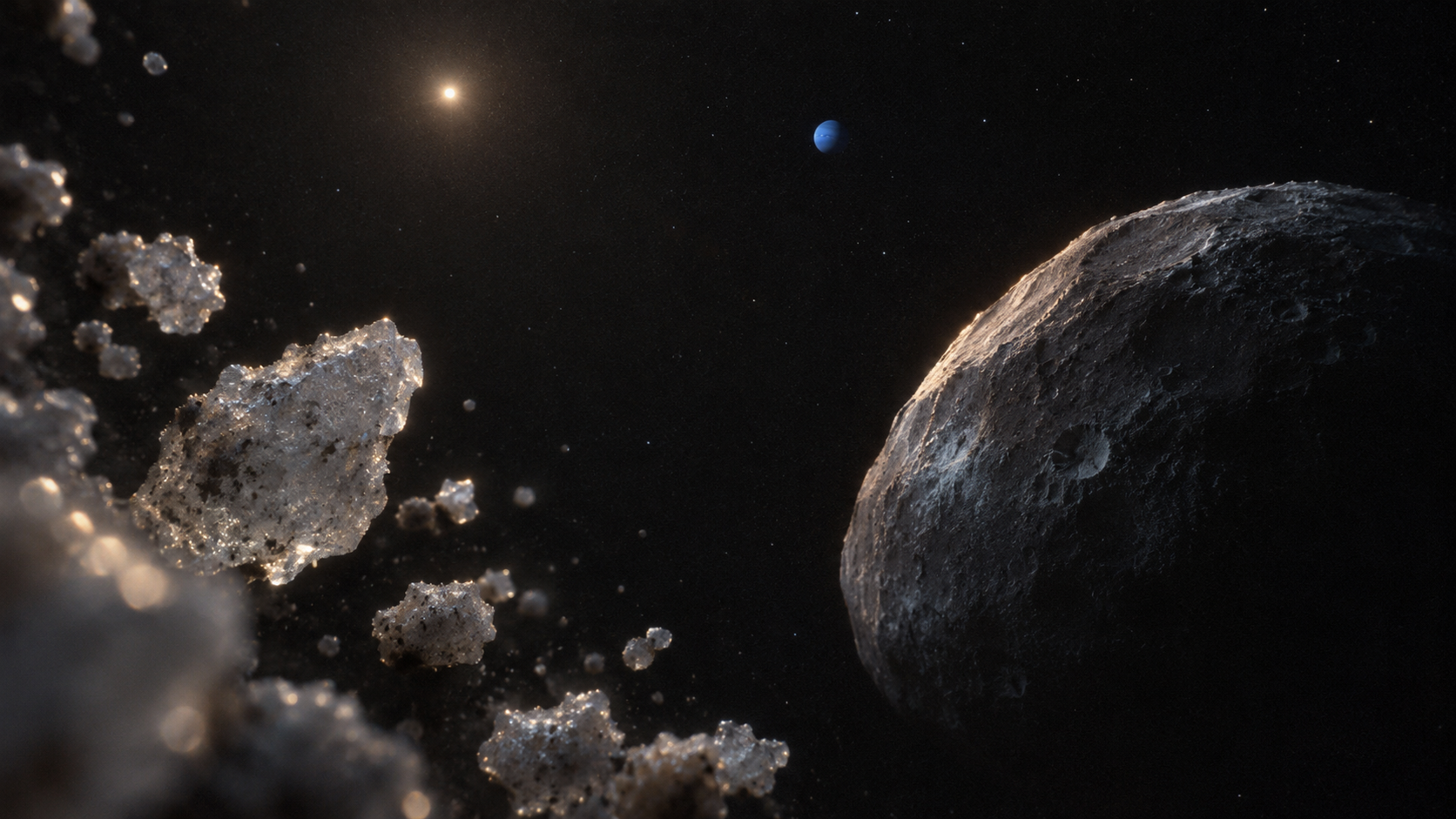
NASA has reported the strongest evidence yet for an ancient reservoir of ice in the Kuiper Belt, the distant region of the Solar System beyond Neptune. The study is based not on telescope observations, but on microscopic particles collected high in Earth’s atmosphere. NASA published the details on 18 November 2026.
Scientists at Johnson Space Center examined 12 dust grains returned from the stratosphere by an ER-2 high-altitude aircraft. Tracks left by solar energetic particles helped connect their origin to the Kuiper Belt. The team then studied their minerals and oxygen isotope composition using NASA electron microscopes and a UCLA ion microprobe.
The samples contained minerals formed when water interacted with dust early in Solar System history. Their chemical signatures indicate that the water was unusually enriched in heavier oxygen isotopes.
Similar signatures are rare in meteorites and samples from carbon-rich asteroids originating closer to the Sun. The researchers suggest that the forming giant planets may have restricted the mixing of material between the outer and inner regions of the young Solar System. The result helps clarify how water and the building blocks of future planets were distributed billions of years ago.
Check the clouds for your location on the NightSkyCast map